When a sales team shared a floor, a manager could hear a deal go wrong. The discovery call that never reached pain. The meeting that ended without a next step. The champion who stopped replying three weeks ago. None of that was reported to anyone. It was ambient, and it was enough.
Distributed teams removed the ambience. What replaced it was reporting. Dashboards, activity counts, weekly pipeline reviews, and a CRM that tells a CRO what already happened across four time zones. Most remote sales team management software was built for exactly this: restoring the visibility that the office used to provide for free.
Visibility is worth having. It is also where most of these platforms stop. A remote team can be fully observed and still execute inconsistently, because knowing what a rep did last week does nothing about what they do on the next call. That is not a tooling failure. It is a gap in the category.
This comparison covers the platforms revenue leaders evaluate when they are running a remote sales team, what each one is genuinely good at, and where each one hands the problem back to the manager.
How to evaluate remote sales team management software
Remote sales management changes the evaluation criteria. Six questions separate the platforms that hold up at distance from the ones that were designed for a manager who could walk over to a desk.
- Timing. Does it report on the past week, or does it change what happens in the next hour? Weekly reporting is a review cadence. Real-time revenue team performance monitoring is an operating cadence.
- Location. A remote rep lives in Slack, email and their calendar. Software that requires them to open a separate tab to receive guidance gets used by the reps who least need it.
- What counts as productivity. Activity counts are the easiest thing to measure remotely and the least useful thing to know. Sales rep productivity is a measure of deal progression, not of hours logged or emails sent.
- Methodology under distance. Methodology holds in an office partly through proximity. Remote, it holds only if something applies it to every deal, for every rep, without the manager present.
- Global coverage. Global sales operations bring data residency, regional CRM hygiene, multi-language calls and regional pipeline rules. Architecture questions decide these, and RevOps decides the deal on them.
- Manager leverage. Every platform promises to save the manager time. The useful test is whether it reduces the number of calls a manager has to sit in to know how a deal is being run.
The platforms
1. Overpath
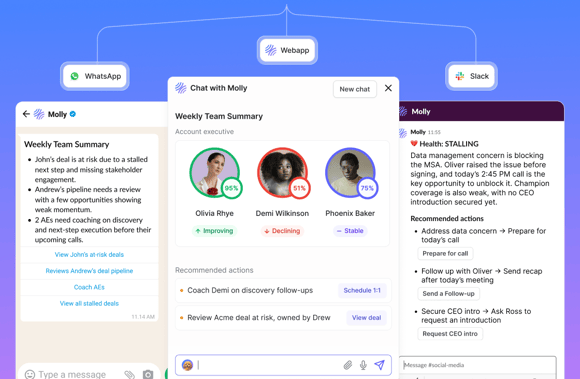
Overpath is the execution layer for revenue teams. It connects to the CRM, calendar, email and call recordings, builds a live picture of every deal, and tells each rep what to do next inside the channels they already work in.
- Best for: Revenue leaders who can see the performance gap between their best rep and the rest of the team and cannot get inside the deals to find where it breaks down.
- What it does: Molly, the AI teammate, works in Slack, Gmail, Google Calendar, Google Meet and the Overpath web app. She delivers pre-call briefings, maps stakeholders across the buying group, scores the deal against MEDDPICC with the evidence attached, flags deal health signals, and writes the CRM update. The coaching is continuous rather than scheduled, which is what makes it survive a distributed team.
- Architecture: Integrations cover HubSpot, Salesforce, Google Workspace and Slack. Overpath holds ISO 27001 certification and CASA verification.
- Where it stops: Overpath is newer to market than the incumbents on this list, and it is deliberately opinionated. It applies a methodology rather than offering a configuration surface for one.
2. Gong
Gong is the established revenue intelligence platform. It records and analyses calls, surfaces conversation patterns at scale, and gives leadership a defensible read on what is happening across the pipeline.
- Best for: Organisations with 50 or more reps that want conversation data and deal risk detection as a system of analysis.
- Strengths: Breadth of call coverage, quality of analysis, and a large body of benchmarking data. For a CRO who has never heard a remote rep’s discovery call, it closes a genuine gap.
- Where it stops: Analysis arrives after the call. It tells a manager what happened and leaves the coaching conversation, and the behaviour change, to the manager.
3. Clari
Clari is built around forecasting and pipeline management. It tracks pipeline movement, flags deals that have gone quiet, and gives a CRO a forecast they can take to a board.
- Best for: Enterprise revenue leaders whose primary exposure is forecast accuracy across regions.
- Strengths: Pipeline inspection, forecast roll-ups and deal movement over time. Strong fit for global sales operations where several regional forecasts have to consolidate.
- Where it stops: The unit of attention is the pipeline, not the rep. It shows a CRO which deals are slipping and not why the rep let them slip.
4. Salesloft
Salesloft manages engagement: cadences, sequences, dialler and email execution, with reporting on rep activity against those cadences.
- Best for: Teams where top-of-funnel volume and consistency of outreach are the bottleneck.
- Strengths: Cadence discipline is one of the few sales behaviours that software enforces well, and Salesloft enforces it. Useful for remote SDR and BDR teams running high volume.
- Where it stops: Engagement execution is not deal execution. It governs how often a rep reaches out, not how well they qualify once someone replies.
5. Outreach
Outreach covers similar ground to Salesloft, with more emphasis on pipeline management and deal-stage workflow alongside sequencing.
- Best for: Mid-market and enterprise teams that want sequencing and pipeline workflow in one place.
- Strengths: Workflow depth and administrative control. RevOps teams can standardise how a remote team works a pipeline.
- Where it stops: The governance is process-level. It standardises the steps and leaves the quality of each step to the rep.
6. Salesforce Sales Cloud and HubSpot Sales Hub

The CRM remains the system of record, and for most remote teams it is the only place where a deal formally exists.
- Best for: Every revenue organisation. This is infrastructure rather than a choice.
- Strengths: Structured pipeline data, reporting, territory and permission models, and an integration surface everything else depends on.
- Where it stops: A CRM records what a rep chose to enter, which makes remote pipeline hygiene a permanent management cost. No CRM has ever made a salesperson sell better.
7. Slack and Microsoft Teams
Communications platforms belong on this list because they are where remote sales management actually happens. The deal room, the escalation, the handover to a solutions engineer, the question a rep asks at 8am before a call. Most remote revenue teams run their day here and their CRM at the end of it.
- Best for: Every distributed revenue team. Channels also carry remote support operations, which is where the account questions that decide a renewal usually surface first.
- Strengths: Adoption is already complete. Asynchronous by design, which matters across time zones, and reps treat it as their working surface rather than a system they report into. Anything that reaches a rep here reaches them immediately.
- Where it stops: A channel carries the conversation and holds no standard. Context scrolls away, the deal record lives somewhere else, and what a manager sees is what a rep chose to post. Sales rep productivity moves through these channels every day and leaves no structured trace of it.
Comparison at a glance
|
Platform
|
Primary job
|
What the CRO gets
|
Where it reaches the rep
|
|
Overpath
|
Execution layer
|
Evidence of how every deal is actually being run
|
Slack, Gmail, Google Calendar, Google Meet, web app
|
|
Gong
|
Revenue intelligence
|
Conversation analysis and deal risk signals
|
Web app, post-call review
|
|
Clari
|
Forecast and pipeline management
|
Forecast accuracy and pipeline movement
|
Web app, forecast submissions
|
|
Salesloft
|
Engagement execution
|
Activity and cadence adherence
|
Web app, email, dialler
|
|
Outreach
|
Sales execution and sequencing
|
Pipeline coverage and rep activity
|
Web app, email, dialler
|
|
Salesforce / HubSpot
|
System of record
|
Structured pipeline data and reporting
|
CRM interface
|
|
Slack / Microsoft Teams
|
Team communication
|
The conversations reps choose to share
|
Slack, Teams, mobile
|
Choosing between them
Most revenue organisations already own three or four of these. The question is rarely which one to buy first. It is which layer is missing.
A CRO who cannot see what is happening in remote deals has an observation problem, and revenue intelligence closes it. A CRO whose forecast moves every week has a pipeline management problem, and forecasting software closes it. A CRO whose outreach volume collapses when nobody is watching has a cadence problem, and engagement platforms close it.
The harder case is the one where all three are already in place. The calls are recorded. The forecast is instrumented. The sequences run. And the same gap persists in every pipeline review: one rep executing the methodology on every deal, and several more executing it when they remember to. That gap survives observation because observation was never going to close it. It is an execution problem, and it needs the execution layer.
What changes when the execution layer is in place
Remote work made the execution gap impossible to ignore. Molly knows the deals inside a week and the reps inside a month. By the end of a quarter the methodology is no longer something the team was trained on. It is actually how they sell.


.jpg?width=2560&height=1600&name=Home%20(1).jpg)
.png?width=48&height=48&name=Favicon%20(1).png)
.jpg?width=3840&height=2160&name=0821(9).jpg)