Kickoff lands in week one. Certification is done by week three. The dashboard goes live in week four and for a fortnight the pipeline looks different - cleaner stages, fuller fields, reps using the language from the deck. Then week six arrives and the team is selling the way it sold in April. Most revenue leaders have watched this happen twice. The reason is simple enough to state in one line: a rollout has an end date, and behaviour that depends on an event ends when the event does.
Every lever a revenue leader has comes with a finish date
Look at what a revenue leader actually has to work with.
There is the workshop, which produces two days of energy.
There is the certification programme, which confirms that people can describe the methodology.
There is the enablement launch, the quarterly business review, the weekly one-to-one, and the manager sitting in on the deals they have time to sit in on.
Every one of these has a start date and a finish. Every one produces a spike in behaviour that begins decaying the moment it ends. Each tool does the job it was built for, and the job it was built for is delivering knowledge on a schedule. But look at what happens in the gaps between those events.
The methodology lives in a slide deck and in the leader's memory. The leader is the enforcement mechanism. That has been the condition of revenue transformation for a decade, and it holds regardless of which framework you rolled out.
The decay is a property of the system
Behaviour that has to be re-initiated stops when nobody initiates it. Enforcement runs on the leader's attention, attention is finite, and it is the first thing to go when the quarter tightens.
Two layers already run permanently
Both of them describe. Neither of them enforces.
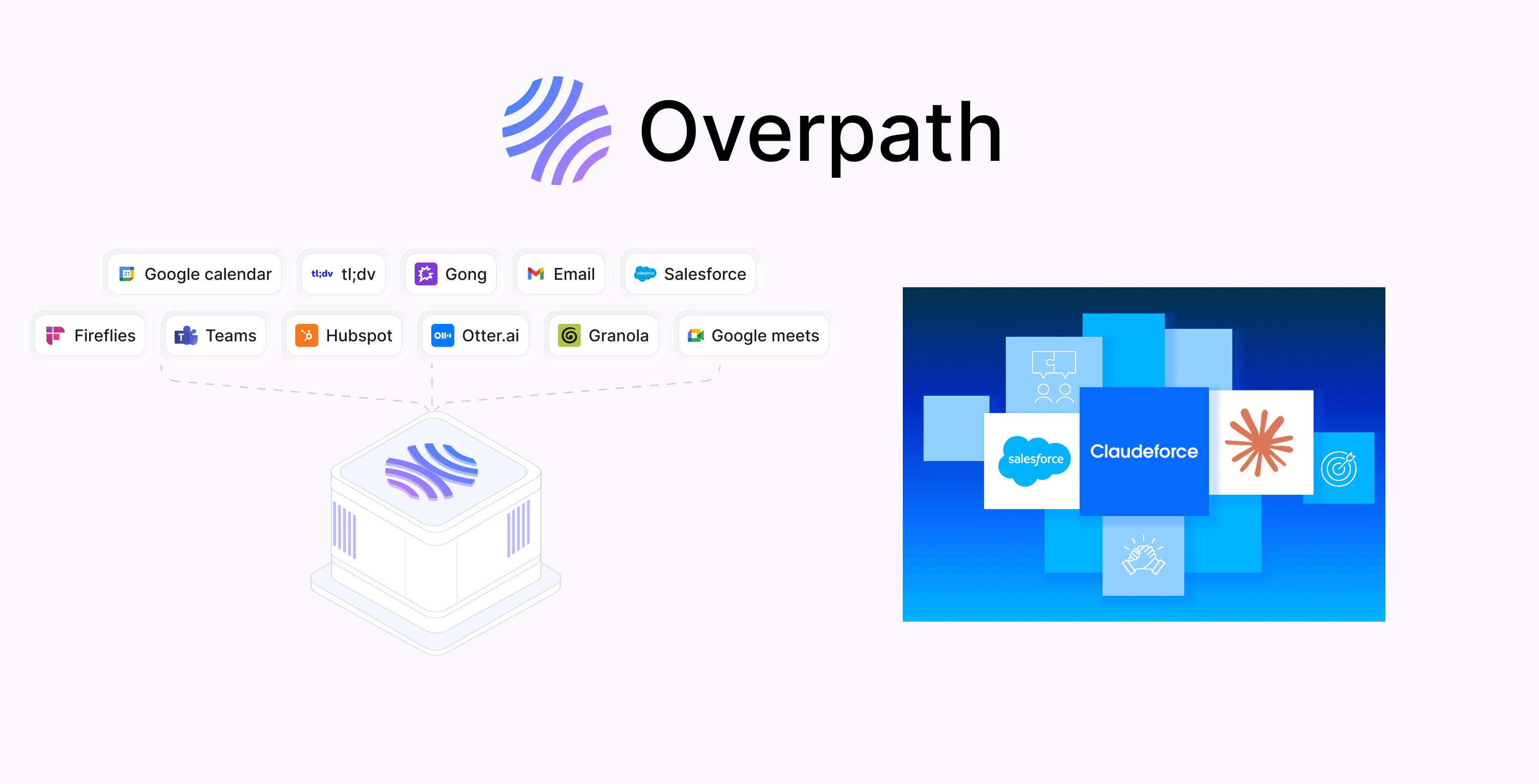
The CRM records what happened, and it does so continuously - no launch date, no champion, no adoption campaign. Intelligence platforms analyse what it means, with the same permanence and the same indifference to whether anyone is paying attention this week. Both layers were built to describe, and they describe well. The layer that acts at the moment of execution has never existed in the stack. Every deal, every call, whether or not a human initiates it. Overpath is the execution layer.
Four conditions any execution layer has to meet
That word deserves a testable definition, because infrastructure is a claim a lot of software makes. Infrastructure sits at the point of work rather than adjacent to it. It runs without the leader in the room. It has no completion date. And it holds the same standard on the deals nobody is watching as on the ones that surface in the forecast review. Hold any vendor against those four conditions, including this one.
The question this changes
If drift is structural, a better-designed rollout produces a better-looking version of the same curve, and they have already run that experiment. The question stops being how to make this one stick. It becomes: what has to be permanently in place for the methodology to hold without me?
A rollout ends. The execution layer runs. That difference is the whole argument, and it is why the methodology holds.

%20(2).jpg?width=3840&height=2160&name=0702(5)%20(2).jpg)
.png?width=48&height=48&name=Favicon%20(1).png)